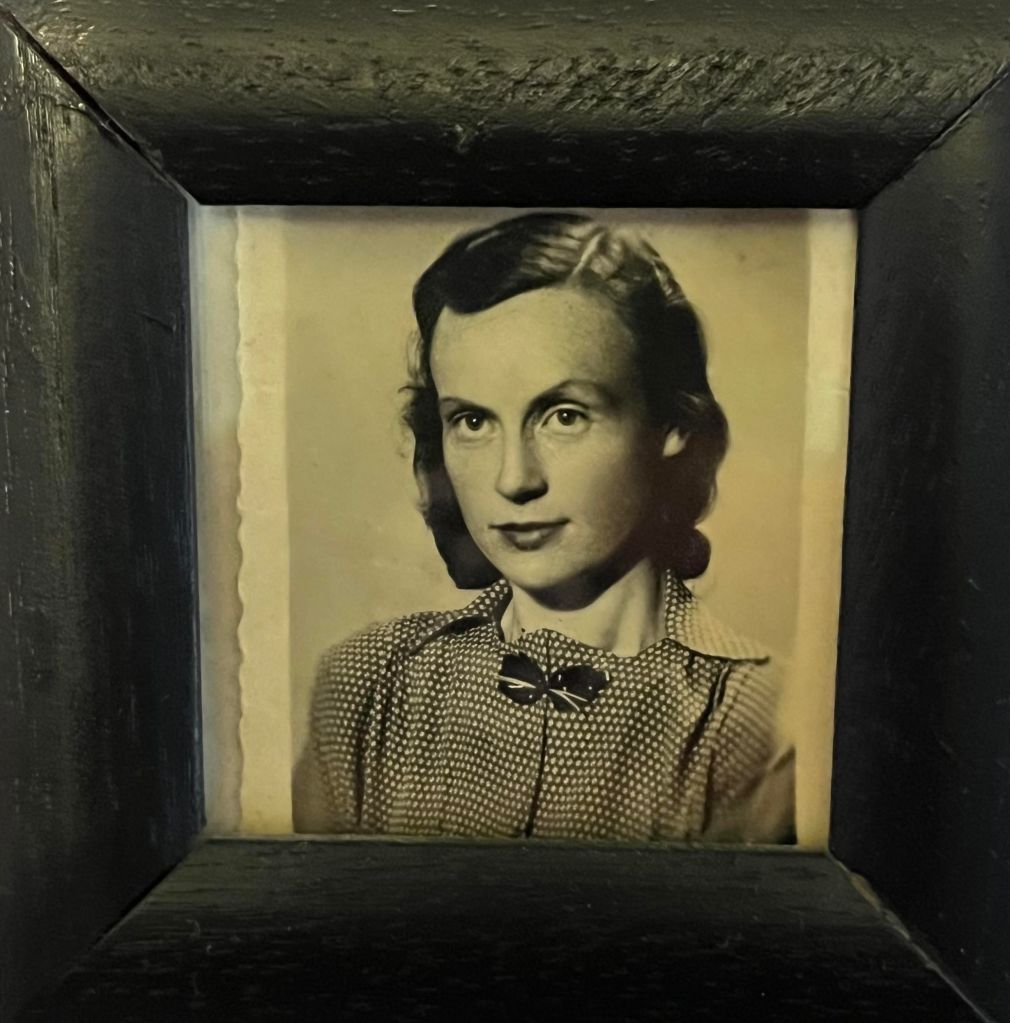
- She was born in the USA on November 12, 1925, and named “Helen” after her paternal grandmother, even though her mother was not pleased with that choice.
- She had no middle name, but perhaps that was more common a century ago. However, she chose “Constance” as her confirmation name, which was the name of her maternal grandmother, so placating her mother.
- She had two First Communions, about two years apart. Her first one was in Claremont, New Hampshire, when she was six years old. The next year, her parents moved the whole family to Poland. The parish priest insisted Helen was too young to receive Communion, so she had to wait a few years until she was allowed to join her peers for another First Communion. (Insert an eye roll here, or a discussion on theology. I won’t be offended.)
- In 1942, Helen’s beloved father was taken away in the middle of the night by Bolshevik sympathizers, during the Soviet occupation of eastern Poland, during which time hundreds of thousands of Polish nationals were also “arrested” or killed. He was taken to a prison camp in Siberia, and Helen never saw him again.
- At the end of World War II, Helen, her mother, and her little brother had to abandon the family farm in far eastern Poland and move to newly-acquired, former German land near the Oder River, since borders were re-drawn. They traveled for ten days by rail, in a boxcar, with other displaced families and probably some animals.
- Helen had incredible sewing skills, which she learned from an aunt, she told me, but I suspect she learned these skills out of necessity. She once showed me how the frayed collar of a men’s shirt could be swapped with the underside of the collar, so prolonging the life of the shirt.
- After the war, Helen worked as the assistant to a notary in the Gorzow office of the Ministry of Justice. Her family assumed she would remain a “career woman” since she did not want to get married. However, Helen’s goal was to return to the USA, and she knew a marriage would make that goal highly unlikely.
- Beginning in the early 1950s, Helen started making plans to leave Poland. However, with Stalin as the ruler of the Soviet Bloc and with the American distrust of Iron Curtain citizens, emigration to the West became nearly impossible. Helen was in possession of a Polish passport, but she never officially became a citizen, since she was just a child when the family returned. This technicality eventually helped to sway officials at the US Embassy in Warsaw, who promised to help her leave. In 1957, Helen was finally able to obtain permission–from the Communist government– to leave Poland for a few weeks, so she could visit her brother in Vermont. Once she got off the plane in Amsterdam, she was escorted to a room where she took a pledge of loyalty to USA and was handed a brand-new US passport. She never returned to Poland.
- During the subsequent years in New England, she was often asked if she was Irish, likely because of her auburn hair and freckles. (I suspect her reply–“No, I am Polish”–was delivered in an icy tone.)
- Soon after her return to the US, Helen moved to Hartford, Connecticut, and enrolled in English-language classes. She met a dashing Peruvian in class, and she told me they dated for a bit, but she broke it off because of cultural differences. I cannot imagine how different my life as “Monica” would have been if that gentleman had ended up as my father.
- Helen obviously preferred Polish men. She and several other single Polish friends were invited to an Easter gathering in Hartford. My dad had travelled from Indiana to visit his war-time buddy, the party’s host, and was obviously out to impress the ladies by volunteering for cooking duty–and he sang as he worked. He was successful! He and Helen started exchanging letters, and they were married the very next January.
- Although she tsk’ed at my father for drinking and smoking (during my early childhood), I do have a few memories of her sneaking a sip and a drag when she thought I wasn’t watching.
- Helen was a big fan of herbal teas and homemade liqueurs, all used for medicinal reasons. (Feeling “nervous”? Have some Valerian root tea. Upset tummy? Let’s brew some chamomile. Bad cough? Here’s a shot of raspberry brandy.)
- Unlike most native Polish speakers, Helen could make the “th” sound–which does not exist in Slavic languages–probably because she learned English as a child in New Hampshire. Even though Helen forgot almost all her English and ended up speaking it with an accent, she liked to tease my dad about how her pronunciation was better than his.
- And speaking of languages: Helen had to study Russian in order to earn her high school diploma, and my dad remembered some from his time as a prisoner of war, so sometimes they would use “broken” Russian (versus Polish) with each other to convey a secret or to swear in frustration. I had no idea what they were saying until years later.
- At the age of 50, Helen decided she wanted to try something new, so she started taking lessons in oil painting from a local artist/friend of the family. She painted dozens of canvases over the next few decades. Several hang in my home, and they bring me joy.
 Monica Lists