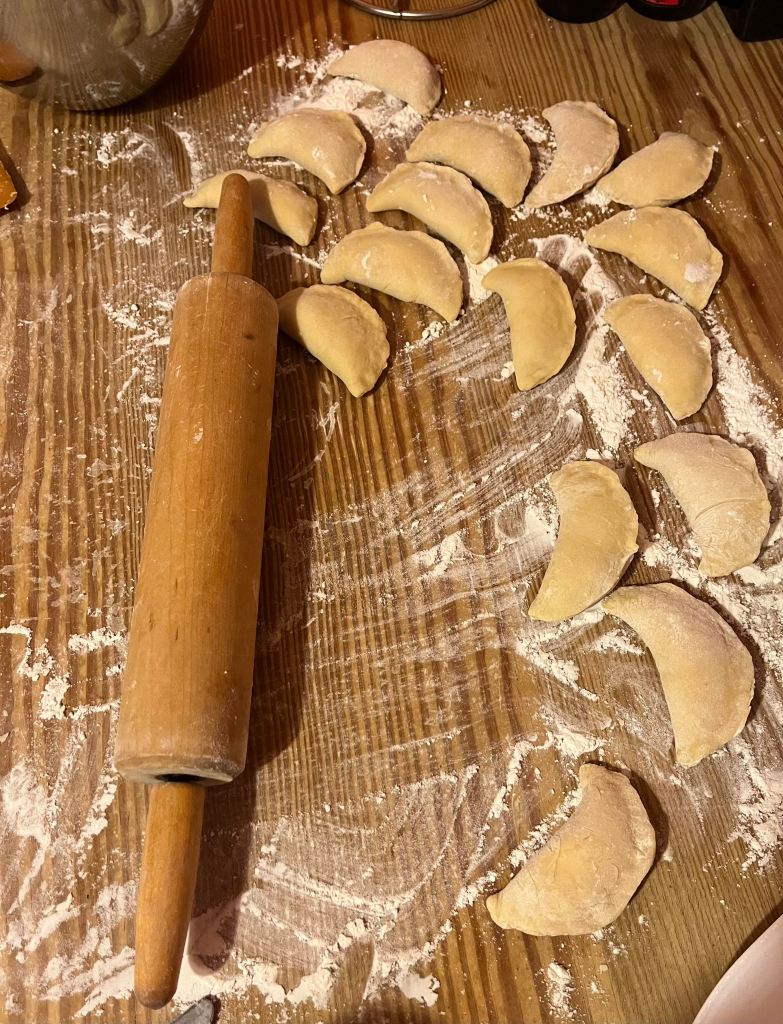
I am retired so I should have the time, even though these dishes are ridiculously labor-intensive.
If my great-grandmothers could make all this and still have time to milk the cows, darn the socks, feed the chickens, and so on, I should be able to handle this in my 21st century kitchen.
I need something to keep me busy as I wait impatiently for my offspring to arrive for the holidays.
I am bonding with countless generations of strong, resilient East European women.
I suppose this is one way to make myself invaluable to the offspring and to the husband, because they do appreciate all the effort I put into this. I think.
If I don’t make all these traditional dishes, my mother’s ghost will no doubt come to haunt me. (It’s still complicated, you know, all the Polish mother guilt I carry.)
Some of these dishes are good for our health, right? I mean, sauerkraut is pickled and good for gut health, and all the fish has great omega-3 fatty acids. And the sour cream has calcium. And the beets help fight inflammation. And the poppy seeds are rich in antioxidants. Right?
The days-long lingering smell of cooked cabbage reminds me of my childhood, and nostalgia is a necessary part of the holiday season.
At least the vodka is easy to obtain.
I want to pass on the beautiful Polish Christmas legacy to my kids and their partners. (And if they let the traditions die, I suppose I could always come back and haunt them.)
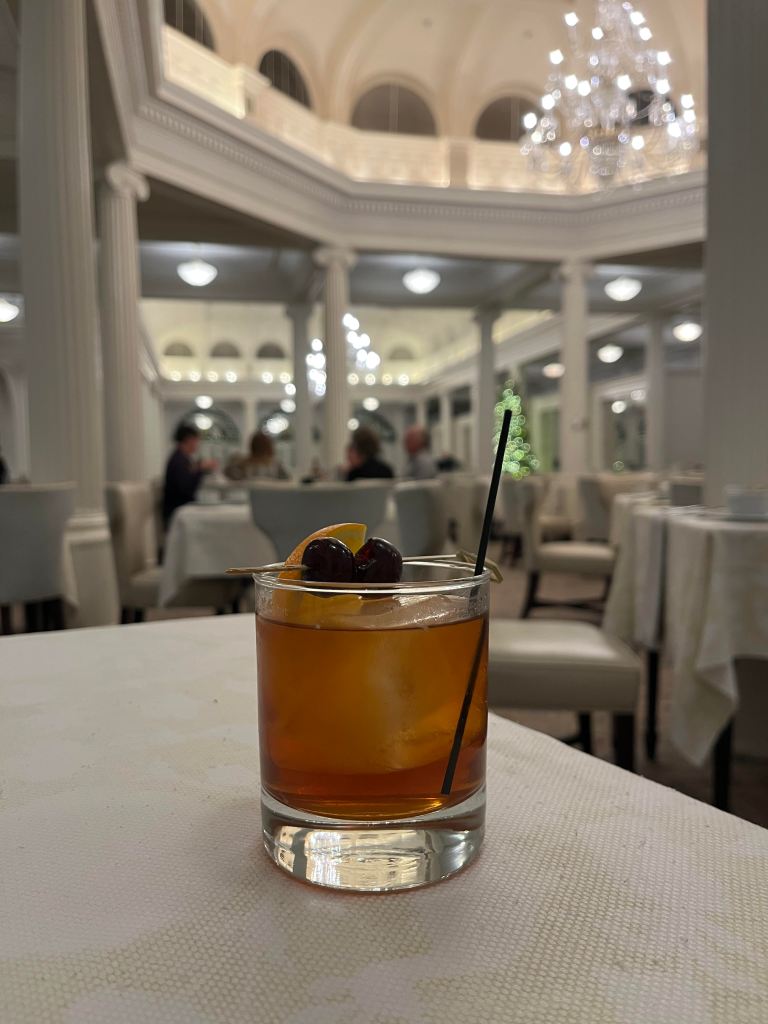
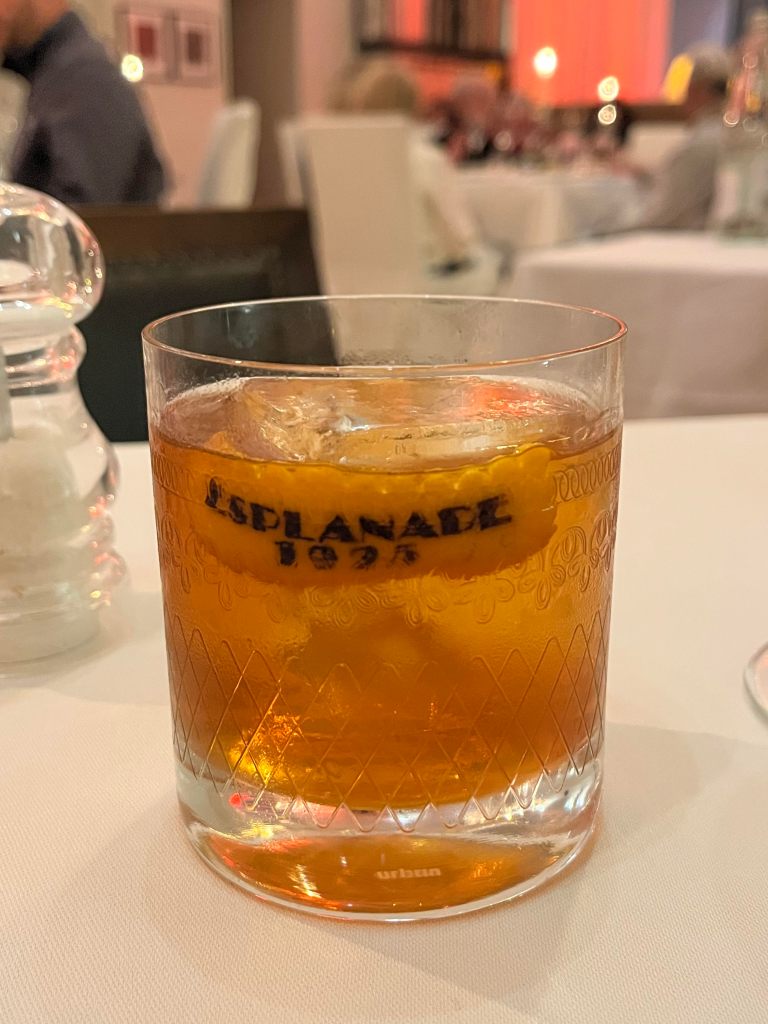
Listed on the menu: Yes, as “Esplanade 1925 Old Fashioned (1960s era).”
Ingredients: Michter’s bourbon, Kilchoman Sanaig Islay Single Malt Scotch, African fruit pepper, orange peel.
The occasion: This was our final night in Zagreb, and our first night of the “official” excursion with our tour agency, who booked us into the most elegant and historic hotel in the city, The Esplanade. Since the restaurant (decorated in shades of pink!) holds a “green” Michelin star, we had to experience it. The meal was superb! What a lovely way to bid goodbye to this charming capital city.
My rating: ***** out of 5. From the start, this drink was out to impress, with “Esplanade 1925”–the name of the Old Fashioned and of the bar!–burned into the accompanying orange peel. Fancy! I am not familiar with “African fruit pepper,” but I assume that it’s an herbal bitter. I am familiar with Kentucky’s Michter bourbon, one of my favorites. The main note of the drink was the smokiness from the scotch, which blended well with the sweet and spicy notes from the other ingredients. The menu stated: “Just like a time machine, it (the cocktail) will take you back to the original experience of New York brokers in the 1960s.” I complimented the bartenders upon departure, and they were eager to show me the bottle of scotch they used. Delicious.
Final thoughts: The hotel website says it better than I can: “Opened in 1925 as a refuge for passengers from the Orient Express, the über-stylish Esplanade Zagreb Hotel is an architectural gem. Located within easy reach of key attractions, the city’s most iconic hotel combines art deco glamour with every contemporary convenience. Long-established as a haven for A-List movie stars, politicians, singers and artists, the hotel’s fairytale exterior and gracious guest accommodation make it easily the most prestigious hotel in Zagreb.” We would happily return!
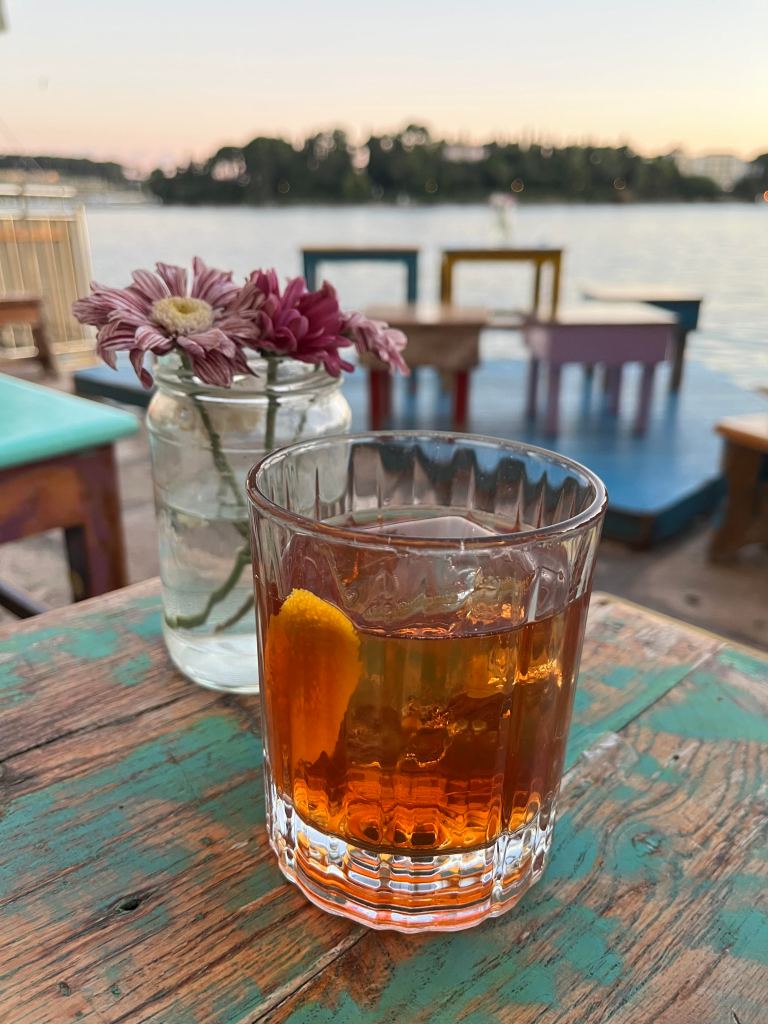
Listed on the menu: Yes, simply as “Old Fashioned.”
Ingredients: Woodford Reserve Bourbon, Muscovado, and Angostura Bitters.
The occasion: This was our first evening in Croatia! We left Venice in the morning, spent the afternoon in lush Motovun, on the gorgeous Istrian Peninsula. For the next two days, our plans were to further explore Istria, and especially the seaside town of Rovinj. Our inn was only a few blocks away from this waterside bar, and we so enjoyed sitting on a bench and watching the sun set over the Adriatic Sea.
My rating: **** out of 5. The muscovado sugar gave the drink a rich, brown sugar sweetness. Woodford is always a good idea, and this cocktail lived up to expectations. I appreciated the orange oil around the edge, which showed me that the young bartender was knowledgeable about this “American” cocktail.
Final thoughts: We wanted to have cocktails in this incredibly-situated bar–it appeared to just hang into the sea–and we will never forget this evening. However, we soon discovered for ourselves that Croatians make delicious and complex wines, so we focused on wines for the next week and a half of our stay. And also, we learned that Croatians will not sit on hard, cold surfaces, for fear of catching a variety of ailments, so every bar provided patrons with ample cushions and lap blankets.
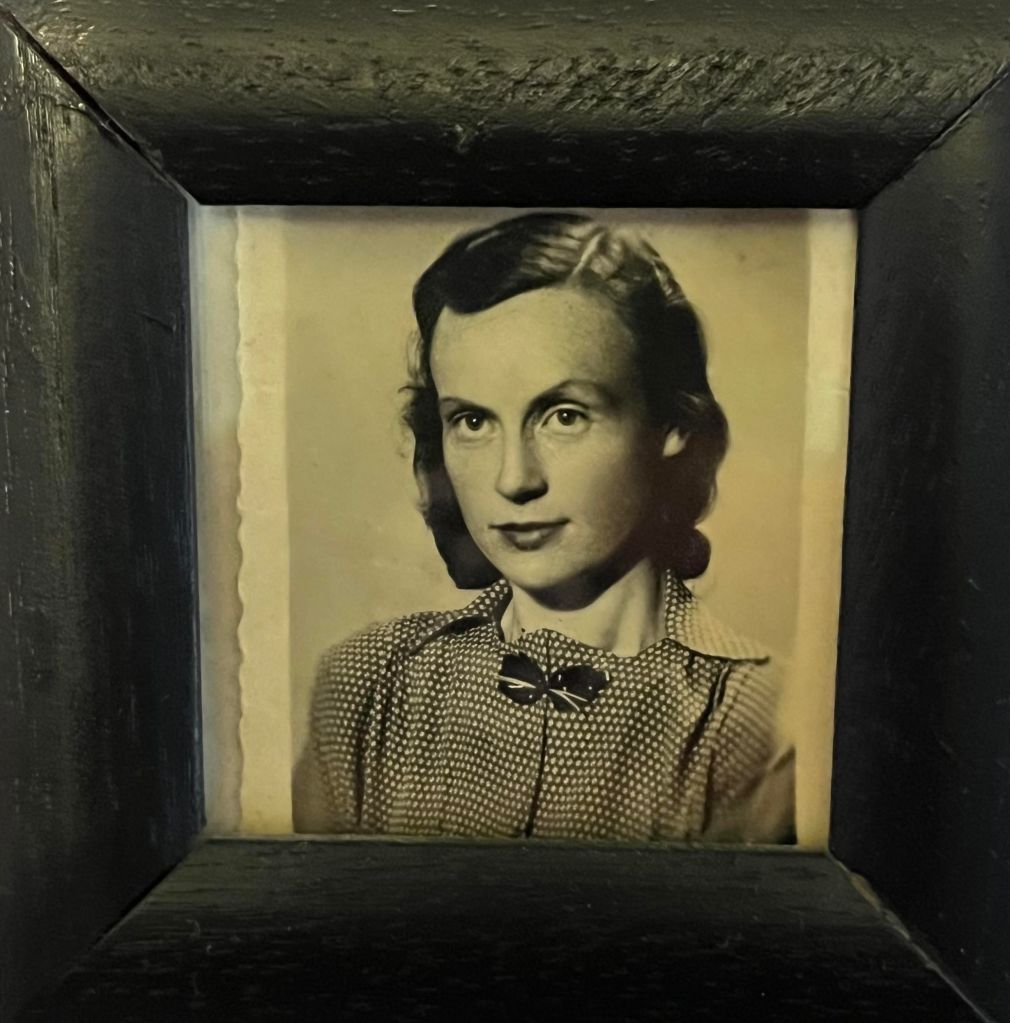
She was born in the USA on November 12, 1925, and named “Helen” after her paternal grandmother, even though her mother was not pleased with that choice.
She had no middle name, but perhaps that was more common a century ago. However, she chose “Constance” as her confirmation name, which was the name of her maternal grandmother, so placating her mother.
She had two First Communions, about two years apart. Her first one was in Claremont, New Hampshire, when she was six years old. The next year, her parents moved the whole family to Poland. The parish priest insisted Helen was too young to receive Communion, so she had to wait a few years until she was allowed to join her peers for another First Communion. (Insert an eye roll here, or a discussion on theology. I won’t be offended.)
In 1942, Helen’s beloved father was taken away in the middle of the night by Bolshevik sympathizers, during the Soviet occupation of eastern Poland, during which time hundreds of thousands of Polish nationals were also “arrested” or killed. He was taken to a prison camp in Siberia, and Helen never saw him again.
At the end of World War II, Helen, her mother, and her little brother had to abandon the family farm in far eastern Poland and move to newly-acquired, former German land near the Oder River, since borders were re-drawn. They traveled for ten days by rail, in a boxcar, with other displaced families and probably some animals.
Helen had incredible sewing skills, which she learned from an aunt, she told me, but I suspect she learned these skills out of necessity. She once showed me how the frayed collar of a men’s shirt could be swapped with the underside of the collar, so prolonging the life of the shirt.
After the war, Helen worked as the assistant to a notary in the Gorzow office of the Ministry of Justice. Her family assumed she would remain a “career woman” since she did not want to get married. However, Helen’s goal was to return to the USA, and she knew a marriage would make that goal highly unlikely.
Beginning in the early 1950s, Helen started making plans to leave Poland. However, with Stalin as the ruler of the Soviet Bloc and with the American distrust of Iron Curtain citizens, emigration to the West became nearly impossible. Helen was in possession of a Polish passport, but she never officially became a citizen, since she was just a child when the family returned. This technicality eventually helped to sway officials at the US Embassy in Warsaw, who promised to help her leave. In 1957, Helen was finally able to obtain permission–from the Communist government– to leave Poland for a few weeks, so she could visit her brother in Vermont. Once she got off the plane in Amsterdam, she was escorted to a room where she took a pledge of loyalty to USA and was handed a brand-new US passport. She never returned to Poland.
During the subsequent years in New England, she was often asked if she was Irish, likely because of her auburn hair and freckles. (I suspect her reply–“No, I am Polish”–was delivered in an icy tone.)
Soon after her return to the US, Helen moved to Hartford, Connecticut, and enrolled in English-language classes. She met a dashing Peruvian in class, and she told me they dated for a bit, but she broke it off because of cultural differences. I cannot imagine how different my life as “Monica” would have been if that gentleman had ended up as my father.
Helen obviously preferred Polish men. She and several other single Polish friends were invited to an Easter gathering in Hartford. My dad had travelled from Indiana to visit his war-time buddy, the party’s host, and was obviously out to impress the ladies by volunteering for cooking duty–and he sang as he worked. He was successful! He and Helen started exchanging letters, and they were married the very next January.
Although she tsk’ed at my father for drinking and smoking (during my early childhood), I do have a few memories of her sneaking a sip and a drag when she thought I wasn’t watching.
Helen was a big fan of herbal teas and homemade liqueurs, all used for medicinal reasons. (Feeling “nervous”? Have some Valerian root tea. Upset tummy? Let’s brew some chamomile. Bad cough? Here’s a shot of raspberry brandy.)
Unlike most native Polish speakers, Helen could make the “th” sound–which does not exist in Slavic languages–probably because she learned English as a child in New Hampshire. Even though Helen forgot almost all her English and ended up speaking it with an accent, she liked to tease my dad about how her pronunciation was better than his.
And speaking of languages: Helen had to study Russian in order to earn her high school diploma, and my dad remembered some from his time as a prisoner of war, so sometimes they would use “broken” Russian (versus Polish) with each other to convey a secret or to swear in frustration. I had no idea what they were saying until years later.
At the age of 50, Helen decided she wanted to try something new, so she started taking lessons in oil painting from a local artist/friend of the family. She painted dozens of canvases over the next few decades. Several hang in my home, and they bring me joy.
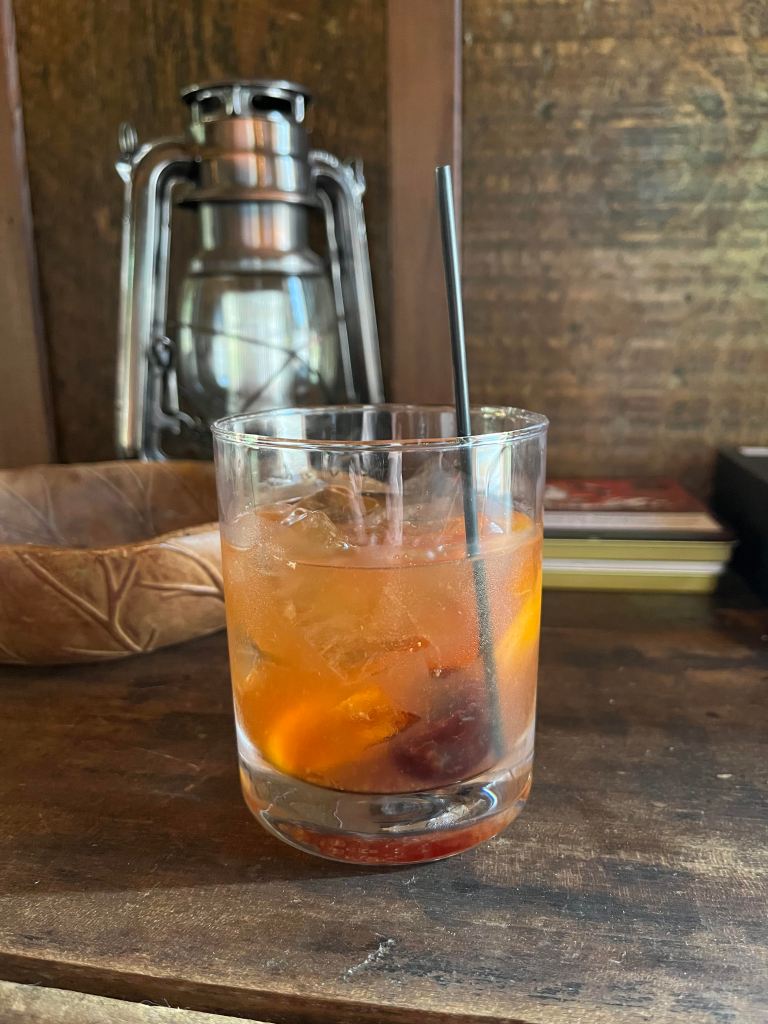
Listed on the menu: No, but the bartender told us he had been mixing drinks professionally for decades, and he had fine-tuned his recipe.
Ingredients: Wood Duck High Rye Bourbon, sprinkle of turbinado sugar, Amarena cherry, muddled orange
The occasion: The day was warm and sunny, so Husband and I decided we needed one last summer swim at Sherando Lake, beautifully situated just a short way from the Blue Ridge Parkway. Devil’s Backbone Basecamp was on the way home, so we stopped in for food and drink. The Shanty was closed when we were there earlier in the summer, so this time we took advantage of sampling the company’s bourbon. The bartender was chatty yet grumpy and served as the entertainment.
My rating: **** out of 5. The cocktail was barely sweet, with definite notes of cherry, caramel, and vanilla. I was surprised that the sugar dissolved so well, and I would have preferred a little less of the orange flavor, even though this is a very traditional way to prepare this drink.
Final thoughts: Devil’s Backbone is perhaps the most successful of our local breweries, since the product is distributed nationwide and the company is now owned by Anheuser-Busch InBev. The Basecamp is impressive, a multi-building campus dedicated to alcohol and food. Happily, our meals were well-prepared, the beer is delicious, the endeavor helps the local economy, and the scenery is pretty, so we felt a little less bad about leaving our money with this huge corporation.
The occasion: We were in the mood for a drive down Virginia’s pretty roads, so we headed north toward Sperryville. We last visited this distillery probably ten years ago, so we were curious to see any changes. Indeed, the selection of products has expanded, and now there is outdoor seating, in a pretty garden overlooking the Thornton River. We each tried a flight and then a cocktail. Sperryville is a charming town, so we explored a bit afterwards and found a lovely spot for lunch.
My rating: **** out of 5. The first flavors I tasted were the sweet and spicy notes of the bourbon, followed then by the strawberry’s juices. I would guess only a few drops of Campari were added, maybe mostly for color. I have only eaten rhubarb baked along with strawberries, so the use of rhubarb bitters made sense. The cocktail was a bit more nuanced due to these additions, I suspect, but the strawberry lingered longer than the other flavors.
Final thoughts: Cute little towns like Sperryville are popular weekend destinations for the Washington-area crowd, especially since Shenandoah National Park and Skyline Drive are so close. We yet again are happy to be retired, so we can experience these places on weekdays, at a gentle pace.
The occasion: This was our final night on the Oregon coast, so we chose a highly-rated seafood restaurant overlooking the harbor. We started the day in Florence, at the Oregon Dunes National Recreation Area, where we rented a side-by-side vehicle and drove it not only over all the dunes, but also along the Pacific Ocean beach! We ate a picnic lunch of locally-made Tillamook cheese, walked up a hill to a lighthouse, then hiked to a five-hundred-plus-year-old Giant Sitka spruce. Needless to say, we had had a full day, so a relaxing supper in a scenic spot was the perfect ending.
My rating: ***** out of 5. I was intrigued by the use of three types of rum in this cocktail, with no whiskey at all. The predominant flavor was burnt sugar cane, which I enjoyed. The citrus flavors lingered at the end. I was not familiar with tiki bitters, but I suspect they helped the drink taste more “Caribbean,” which was perfect alongside all the the seasonal locally-caught fish, such as black cod, which I ordered.
Final thoughts: Four days and nights along the Oregon coast was not long enough. We experienced so much rugged natural beauty, yet missed several opportunities to see even more due to the marine layer and the pockets of fog that would creep up unexpectedly. Still, we loved our trip and hope to return.
The occasion: After a several day visit with Daughter in Seattle, we rented a car and headed for the picturesque Oregon coast. I have a long-standing interest in the Lewis and Clark Expedition, probably because we live in Albemarle County, Virginia, the birthplace of both men, and the location of Thomas Jefferson’s home, Monticello. In fact, many of the artifacts sent back from the Expedition to Jefferson are still on display at Monticello. The initial details for the trip were drafted here, so going to the “edge of the continent” to see the terminus of the Expedition (“Ocean in view! O! the joy”) has always been a goal of mine. We stopped at several Lewis and Clark Trail points of interest near Astoria, such as Fort Clatsop and Cape Disappointment.
My rating: ***** out of 5. I wanted to try a local bourbon, so the Burnside was a logical choice. The drink was well-balanced, with the bourbon being the most prevalent taste. Burnside has a 70% corn mash bill, and the sweet notes were obvious. Since simple syrup was not listed as an ingredient, I wonder if the soda used (it must have just been a splash) was sweetened.
Final thoughts: We stayed two nights in Astoria, at the four-mile wide mouth of the mighty Columbia River. The city, the first permanent American settlement west of the Rocky Mountains, was founded in 1811 as a fur-trading outpost and named for tycoon John Jacob Astor, who was then the richest man in America. Astoria experienced a salmon canning boom in the 1870s and quickly became the salmon canning capital of the world. Unfortunately, over the decades, the salmon were over-fished in this area, and the last cannery closed in 1980. The remaining industrial buildings have been re-purposed into museums, shops, hotels, and restaurants, such as the Bridgewater Bistro. We happily dined at a table overlooking the river and the gorgeous sunset. Our AirBnB was likewise in a re-purposed building on Pier 12, so we were able to watch the shipping activity from the large picture windows in our suite of rooms–truly one of the most unique places we have ever slept!
Dear Husband normally hates posing for photos, but he will begrudgingly agree to smile at the camera if I am with him.
The internet is forever, so I will be able to access these photos a decade or two or three from now and then sigh in resignation about how marvelous I looked in 2025.
Looking back at old photo albums, I see countless photos of my children and my husband, and so few snapshots of me. That’s because I WAS THE ONE who always remembered to bring the camera out and to use it. I really was there at all those family events, yet there is little proof. Admittedly, those clunky cameras and camcorders of the 1990s didn’t really make it easy to turn the lens on oneself but still! I was younger and thinner and blonder–does anyone remember that? Well, now I can take care of my bitterness (and my vanity, I suppose) and take countless selfies of me, myself, and I. So there.
My awkward smiles, jowls, and wrinkles should make the rest of you feel really good about yourselves and the way you look. You’re welcome.
My offspring laugh at these shots, and probably occasionally roll their eyes. It’s still my job to cheer them up, you know.
And years from now, when I am gone from this world, but since the internet is forever, my offspring can reminisce about how awesome their parents were, and about how much they miss their mom in particular. (Polish mother guilt transmitted from the grave!)
I paid a lot for my iPhone, so I might as well use it.
Taking selfies on a regular basis keeps my photography skills sharp. And writing about the adventures that go along with the selfies should keep my brain sharp. I could write an article about this for AARP Magazine!
I guess I want all of you to feel a bit jealous of our life as a retired couple.
Sometimes it just feels good to stretch my arms all the way out.
The occasion: We spent the late morning exploring the architecture of Columbus via a handy phone app. We opted for ice cream for lunch at the iconic Zaharakos Ice Cream Parlor, then we joined a guided tour of the Miller House and Gardens. The day ended with cocktails and a lovely supper right in downtown Columbus.
My rating: **** out of 5. I wondered if the drink would be dominated by the cherry liqueur, but it was well-balanced and the bourbon flavors came through without too much sweetness. My objection was the lemon twist, which overshadowed the orange twist and made the cocktail smell too citrusy.
Final thoughts: Columbus is amazing! The city deserves all its awards and accolades. We stopped at public buildings designed by Eliel Saarinen, Eero Saarinen, Kevin Roche, and I.M. Pei, among others. After all of these years of visiting Indianapolis (and going to school in central Indiana), Husband and I finally carved out the time to drive down and see why the area is a destination for art and modern architecture lovers. This city of 46,000 residents boasts a whopping seven buildings recognized by the National Historic Landmarks program. (I believe we found five.) We were impressed, and we would love to go back to see even more–one day was definitely not enough.